Category: Pastoral Reflections

  • Assurance, Not Chronology: Why Paul Says We’re Already “Glorified”

    Romans 8:28–30 contains one of the most comforting (and most misunderstood)statements in all of Scripture. Paul writes that those whom God justified, “he also glorified.”

    At first glance, that raises a question: How can glorification be past tense when we’re clearly not glorified yet? We still suffer. We still groan. We still bury our dead and battle sin.

    The mistake is assuming Paul is giving us a timeline. He’s not. He’s giving us assurance.

    When Paul says, “those he justified, he also glorified,” he isn’t laying out the order or timing of salvation events the way a systematic theology chart might. He’s doing something far more pastoral…and far more powerful.

    1. Paul Is Speaking to Anxious, Suffering Believers

    Romans 8 is not written to people living comfortable, settled lives. It’s written to believers who are hurting.

    Paul explicitly mentions that they are:

    • Suffering (8:17–18)
    • Groaning along with creation itself (8:22–23)
    • Weak and unsure, often not even knowing how to pray (8:26)
    • Facing opposition, loss, and persecution (8:35–36)

    So the driving question of the chapter is not:

    “When exactly will glorification happen?”

    The real question is:

    “Can anything stop God from finishing what He started?”

    Paul’s answer is a resounding no.

    2. The Past Tense Communicates Certainty, Not Sequence

    In Greek, and throughout Scripture more broadly, the past tense (especially the aorist) often emphasizes completeness, not timing.

    Paul’s point is not:

    “First this happened, then that happened, and now glorification has already occurred.”

    His point is:

    “Everyone God justifies will, without exception, be glorified.”

    By using past tense language, Paul is saying:

    • God’s saving purpose is whole
    • God’s saving plan is unbreakable
    • God’s saving work moves from beginning to end without loss

    The grammar doesn’t underline calendar placement. It underlines certainty.

    3. Paul Collapses Time to Strengthen Hope

    Paul intentionally pulls the future into the present…not to confuse believers, but to reassure them.

    Think of it this way:

    • From our perspective: glorification is future
    • From God’s purpose: glorification is settled

    Paul is speaking from the standpoint of God’s saving decree, not human experience.

    Paul’s message is simple but profound: God’s promise is so firm that it can be spoken of as history.

    4. Why Chronology Misses the Point

    If Paul were focused on chronology, Romans 8:30 would raise all kinds of problems:

    • Why isn’t sanctification mentioned?
    • Why is glorification past tense?
    • Why are suffering and groaning still so real?

    But those questions fade once we see Paul’s purpose.

    He isn’t building a theological flowchart. He is:

    • Anchoring assurance
    • Quieting fear
    • Strengthening perseverance

    Romans 8:30 functions more like a legal declaration than a timeline. The verdict has already been rendered.

    5. The Pastoral Payoff

    Here’s the heart of Paul’s move:

    If God has already decided the end, then your present suffering cannot undo it.

    So…when believers feel:

    • fragile
    • threatened
    • uncertain about the future

    Paul says, in effect:

    Your glorification is not hanging in the balance. It is already secured in God’s saving purpose.

    That’s why Romans 8 immediately flows into questions like:

    • “If God is for us, who is against us?” (8:31)
    • “Who can bring an accusation against God’s elect?” (8:33)
    • “Who can separate us from the love of Christ?” (8:35)

    Those questions only make sense if glorification is guaranteed, not tentative.

    A Clean Summary

    Paul uses past tense language to assure believers that God’s saving work will not fail. He is not mapping the timeline of salvation. He is declaring the certainty of its outcome.

    For weary Christians, that’s not a technical detail. It’s oxygen.

  • The Armor of God: Christ Applied to Daily Life

    When Paul talks about the armor of God in Ephesians 6, he’s not asking us to picture ourselves suiting up with invisible gear like some kind of spiritual superhero. Paul has something far deeper in mind. The armor is not a mystical ritual or a mental exercise. It’s a picture of what it looks like to live each day in union with Christ.

    Union with Christ is one of the most beautiful truths in the New Testament. It means that through faith, the believer is joined to Jesus in such a way that everything He has done, everything He gives, and everything He is becomes the source of our life. The Christian doesn’t stand in the battle alone; he stands in Jesus.

    Let me break this down in a way that’s simple, biblical, and deeply encouraging.

    1. Christ is not just with you. You are in Him.

    Paul’s favorite phrase in Ephesians is “in Him.”
    “In Him we have redemption.”
    “In Him we were chosen.”
    “In Him you also were sealed.”

    Those aren’t poetic expressions. They’re describing a new spiritual reality.

    Christ isn’t merely beside you cheering you on. You are united with Him. His life shapes your life. His power strengthens your weakness. His victory covers your struggle.

    We don’t follow Jesus from a distance. We participate in all that He is.

    2. The armor is really “Christ Himself” given to you.

    Every piece of armor Paul lists is simply a different angle on who Jesus is and what He provides.

    • Truth – Jesus is the truth.
    • Righteousness – Jesus is our righteousness.
    • Gospel peace – Jesus is our peace.
    • Faith – Jesus is the faithful and trustworthy One.
    • Salvation – Jesus is our Savior.
    • The Word – Jesus is the Word made flesh.

    Putting on the armor isn’t imagining a helmet and shield. It’s putting on Christ Himself (Romans 13:14).

    That means the armor is relational, not mechanical. We don’t “gear up” by formulas. We draw near to Christ.

    3. Union with Christ means His strength becomes your strength.

    Spiritual warfare doesn’t begin with our effort.
    It begins with His supply.

    You aren’t trying to scrape together enough truth, righteousness, peace, faith, and hope to hold your life together. You receive those things as gifts from the One you are united with.

    It’s like plugging a lamp into the outlet…the lamp shines, but the power isn’t coming from the lamp.

    The Christian shines because he is connected to Christ.

    4. Union with Christ means you fight in His victory, not yours.

    Christ has already triumphed over rulers, authorities, and every spiritual power (Ephesians 1:20–23). The decisive battle has been won. The war is not about earning victory but standing in the One who already secured it.

    You don’t fight for victory. You fight from victory.

    Your enemy is real, but he is defeated. Your struggle is serious, but it’s not uncertain.

    Because you are in Christ, His triumph shapes your fight.

    5. Union with Christ is daily. So, the armor is daily.

    Putting on the armor is not a one-time “spiritual moment.”
    It’s a lifestyle of walking in the reality of Christ’s presence and power.

    It looks like:

    • Thinking with His truth.
    • Resting in His righteousness.
    • Walking in His peace.
    • Trusting His promises.
    • Anchoring your mind in His salvation.
    • Using His Word with wisdom and humility.

    This is the armor.
    This is the Christian life lived in Christ.

    The Big Picture

    The armor of God is simply the gospel applied. And the gospel connects us to Christ Himself.

    If you are in Christ, you are never unarmed, never unprotected, never alone. Every piece of armor is already yours in Him. The daily call is to remember it, live in it, and stand firm.

    Stand in Christ…and stand strong.

  • The Hidden Danger in Helping

    Why Pastoral Care Sometimes Hinders Growth—and How to Set Loving Boundaries

    In pastoral ministry, one of my greatest joys is walking with people as they grow in Christ. I listen, pray, teach, and encourage—often in moments of deep pain. But sometimes, a relationship that began in healthy discipleship can quietly shift into something else: dependency.

    What I Mean by “Dependency”

    I’m not talking about the beautiful, biblical kind of dependence on Christ or healthy mutual care within the church family. I’m talking about when a person begins to lean on you—their pastor, mentor, or friend—in a way that replaces leaning on the Lord or on the body of believers as a whole.

    In some cases, it may even become codependency, where both sides unintentionally reinforce the unhealthy attachment. In dependency, the burden flows mainly one way—the person becomes emotionally or spiritually reliant on a single relationship for stability, security, or identity.

    It can happen slowly, and it’s rarely intentional. But left unchecked, it stunts spiritual growth for both people and can become damaging over time.


    Red Flags of Unhealthy Dependency

    From experience, here are a few signs that a pastoral or mentoring relationship might have drifted from healthy discipleship toward dependency:

    1. Constant crisis contact – The person reaches out almost every time they feel hurt, anxious, or unsure—often before they pray or seek God’s Word themselves.
    2. Discomfort with absence – Even brief unavailability (a day or two without response) is interpreted as rejection or abandonment.
    3. Exclusive trust – They resist advice to seek counsel from others, especially within their own local church.
    4. Role confusion – They begin to see you as a surrogate parent, sibling, or sole confidant rather than a pastor or brother/sister in Christ.
    5. Emotional escalation – Conversations regularly spiral into intense emotions that center on your availability rather than on Christ’s sufficiency.
    6. Spiritual stagnation – Their walk with the Lord doesn’t seem to progress unless you are actively leading, prompting, or explaining.

    These aren’t signs to condemn someone—they’re signs to lovingly intervene before harm is done.


    Why It’s Spiritually Dangerous

    When we allow dependency to grow unchecked, the other person may begin to see us as their savior, refuge, or source of wisdom rather than Jesus Christ. In some cases, they may even avoid facing hard truths because our presence makes it easier to cope without real change.

    For the one providing care, the danger is more subtle: we can start to feel irreplaceable, needed, or even responsible for their spiritual life. That’s a burden only the Lord can carry.


    Setting Loving Boundaries

    Boundaries aren’t punishment. They’re a gift—both for the other person’s growth and for our own faithfulness. I haven’t always been good at this. But, I’ve tried to learn. Here’s how I try to set them with compassion:

    1. Affirm care and commitment
      Let them know you love them and are praying for them. Make it clear that the boundary is about helping them grow, not about rejection. “I care deeply for you, and I want to see you grow in Christ. That means I can’t be the only person you turn to for counsel. I want to encourage you to lean into Jesus and into your church family.”
    2. Clarify the role
      Remind them that your role is to equip and point them to Christ—not to replace Him.
    3. Encourage other connections
      Direct them toward pastors, small group leaders, or mature believers in their church. Encourage them to share questions or prayer requests with those people first.
    4. Set specific limits
      Define when and how you’ll respond to messages, and what kinds of conversations you can have.
    5. Release the outcome
      They may feel hurt or even accuse you of abandonment. You can’t control that. Your responsibility is to love them, pray for them, and trust the Holy Spirit to work.

    A Pastoral Encouragement

    It’s not easy to walk away from an unhealthy pattern, especially when the other person is hurting. I’ve had to do this myself, and it never feels good in the moment. But Scripture reminds us:

    “He must increase, but I must decrease.” – John 3:30

    If we truly want someone to grow, we must sometimes step out of the way so they can see Christ more clearly. That may mean they lean on others in the body, wrestle in prayer, or search Scripture themselves before reaching out.

    As shepherds, our call is to point to the Chief Shepherd. When someone moves from needing us to needing Him, even through painful boundaries, that’s not failure—it’s fruit.

  • What Comes After the Tears? Worship

    Post 3 of 3 // Psalm 51

    David’s repentance doesn’t end in silence. It ends in singing.

    “Then I will teach the rebellious your ways… Lord, open my lips, and my mouth will declare your praise.”

    This is the fruit of forgiveness. When God heals your heart, your mouth can’t stay closed. Brokenness becomes a testimony. Mercy becomes music.

    True repentance always bears fruit. Not perfection, but praise. Not shame, but surrender. David says God delights not in sacrifices but in “a broken and contrite heart.” The beauty of the gospel is that Jesus takes our wreckage and turns it into worship.

    So don’t believe the lie that your past disqualifies you. Your scars can sing. Your failure can preach. God uses humbled hearts to reach hurting people.

    Reflection: What would it look like to let your story become someone else’s hope?

    Prayer: Jesus, thank You for making my praise possible. Use my life to speak of Your mercy and lead others back to You.

  • Create in Me a Clean Heart: When You Need a Do-Over

    Post 2 of 3 \\ Psalm 51

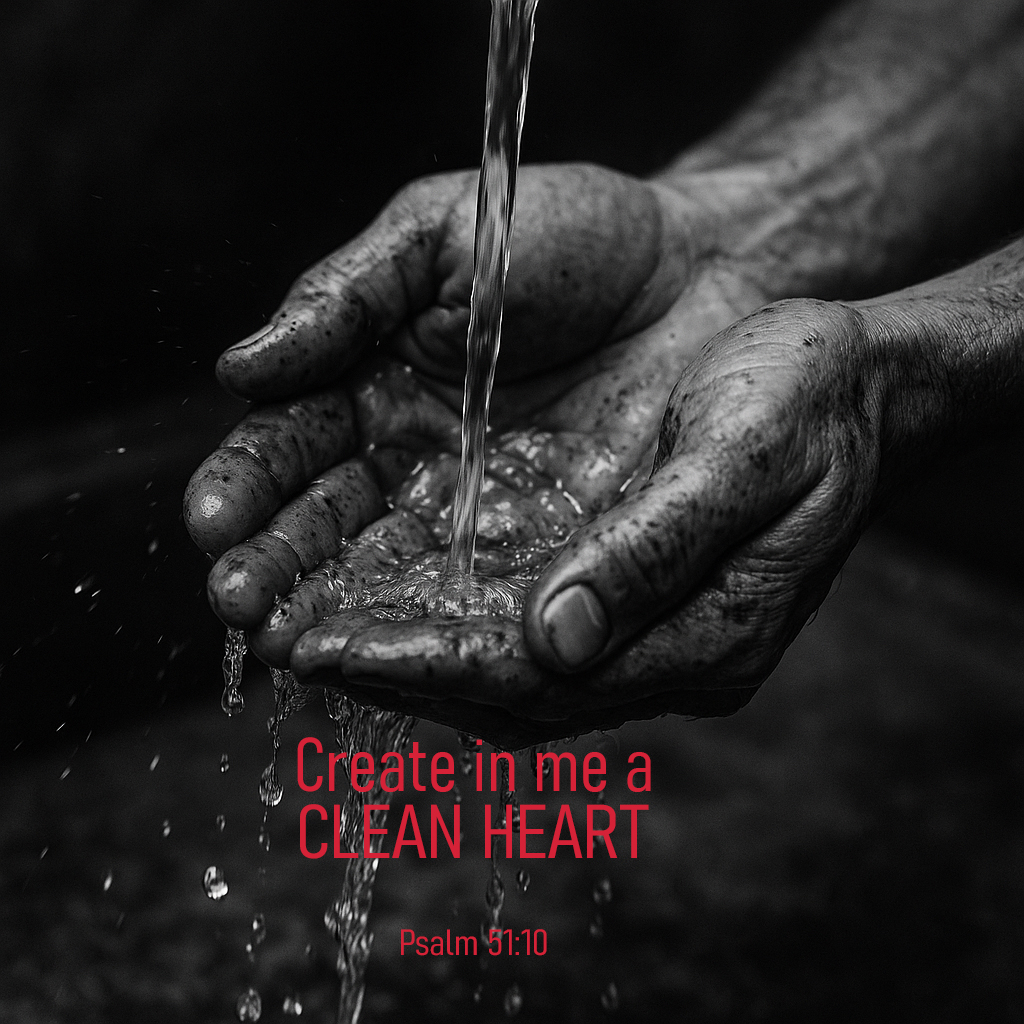
    We all know the feeling of regret. The shame that sticks. The moments we wish we could rewind. David had those too. But instead of wallowing in guilt, he cried out: “Create in me a clean heart, God, and renew a steadfast spirit within me.”

    Notice that word: create. David doesn’t ask for a touch-up. He doesn’t say, “Make my old heart work again.” He asks for something brand new.

    That’s the kind of mercy God gives. Not a repair job. Not spiritual Febreze. A total do-over.

    Reflection: What parts of your life feel too broken for restoration?

    Through Christ, the God who spoke galaxies into being speaks new life into broken people. He makes us new from the inside out. That’s not just doctrine. That’s hope.

    Prayer: Father, I need more than a second chance. I need a new heart. Make me new by Your Spirit and keep me close.

  • Sin Isn’t Just About What You Did—It’s About Who You Offended

    Post 1 of 3 \\ Psalm 51

    David’s words hit hard: “Against you—you alone—I have sinned and done this evil in your sight.” He’s just been exposed for adultery and murder. He’s hurt Bathsheba, Uriah, and the whole kingdom. Yet he says his sin is ultimately against God. How?

    Because sin, at its root, isn’t just a horizontal problem. It’s a vertical rebellion. Sin is what happens when we dethrone God and put ourselves in His place. It’s more than breaking a rule—it’s betraying a relationship.

    Reflection: When was the last time your heart broke over sin, not just your consequences?

    That truth should humble us. It should also change how we repent. Real repentance doesn’t just say, “I messed up.” It says, “Lord, I wounded Your heart. I rejected Your authority. I need Your mercy.”

    And here’s the good news: the God we offended is also the God who invites us back. Because of Jesus, sinners can be restored to the very presence we were made for.

    Prayer: Lord, I confess that I have sinned against You. Not just in behavior, but in heart. Forgive me, and draw me near.

  • Kiss the Son: Finding Refuge in the Reigning King

    Our world is no stranger to rebellion. From headlines to hashtags, we see it—nations raging, people plotting, the world pushing against any notion of divine authority. But none of this surprises God.

    Psalm 2 shows us that rebellion is not a new thing—it’s the natural posture of the human heart apart from grace. The kings of the earth rise up and say, “Let’s tear off their chains…” They see God’s law as bondage instead of blessing. And whether they know it or not, when they reject the Lord, they are also rejecting His Anointed—ultimately, Jesus Christ.

    But God is not shaken.

    He sits enthroned. He laughs—not in scorn, but in sovereign assurance. His response to rebellion is not anxiety—it’s proclamation: “I have installed my King.” This isn’t a political reaction. It’s a redemptive reality.

    Psalm 2 declares a King who is both Savior and Judge. “You are my Son,” God says, and Jesus is that Son. The nations belong to Him. Judgment is real. And yet, before the rod of iron falls, a cross of mercy stands.

    The psalm ends with a plea: “Kiss the Son… All who take refuge in Him are blessed.” Even rulers are invited to bow in worship. Reverence and joy go hand-in-hand. Worship isn’t casual; it’s a trembling delight in the reign of Christ.

    Here’s the good news: The King who has the right to crush us is the One who offers us shelter. There is safety—refuge!—in surrendering to Him. The safest place in the universe is at the feet of Jesus.

    Don’t fear the chaos of the age. Don’t follow the rebellion of the world. Fear the Lord. Kiss the Son. And find your rest in His reign.

  • Two Paths. One Savior.

    This past Sunday was a special one — my first Sunday as pastor at Star Hope Baptist Church. And there’s no better place to begin than Psalm 1.

    Psalm 1 is more than the first chapter in the Psalms — it’s the front door to the whole book. It invites us in… and it also forces us to decide.

    There are only two paths in life, the psalmist says:
    – One that’s rooted, fruitful, and known by God.
    – And one that’s hollow, drifting, and headed toward ruin.

    We don’t like stark choices like that. But Psalm 1 is lovingly clear. And it doesn’t just show us the difference between the righteous and the wicked — it shows us the difference between real life and spiritual death.

    The way of the righteous is marked by delight in God’s Word. Not just reading it out of duty, but loving it. Meditating on it. Letting it shape how we think, how we live, how we treat people.

    The blessed person in Psalm 1 is like a tree — planted, nourished, strong. That kind of life doesn’t come from self-help. It comes from being rooted in God’s truth.

    The wicked, on the other hand, are compared to chaff — that thin, useless husk that blows away in the wind. It looks like something… until the storm hits. And then it’s gone.

    I told a story Sunday about two friends. One stayed grounded in Scripture and stood strong through trial. The other slowly drifted from God’s Word — and when life hit hard, he had nothing to hold him. That’s not just an illustration. It’s real life. I’ve seen it again and again.

    Psalm 1 calls us to examine our direction.
    Are we being shaped more by the voices of the world… or by the voice of God?
    Are we building lives that will stand… or lives that will scatter when the winds pick up?

    Here’s the good news: Jesus is the truly Blessed Man. He walked the path of righteousness for us. He rejected evil, delighted in the Father’s will, and bore our judgment on the cross. Now, by faith in Him, we can be planted — forgiven, fruitful, and secure forever.

    So the question Psalm 1 asks us is simple and urgent:

    Which path are you on?

    One leads to life.
    One leads to ruin.
    And only one Savior can put you on the right road.

    Let’s be people of the Word.
    Let’s be rooted.
    Let’s walk the path that leads to life.

  • His Only Banner Over Me Is Love

    Sometimes I feel like I’m being pulled in every direction—responsibilities, distractions, expectations, and the occasional temptation to chase after things that never satisfy. In those moments, it’s not that I’ve forgotten who Jesus is… it’s that I’ve wandered from remembering who I am to Him.

    There’s a lyric form an old Petra song (“First Love”) that always grabs my heart:

    “Your only banner over me is love.”

    It echoes a verse tucked into the love poetry of Song of Solomon 2:4:

    “He brought me to the banqueting house, and His banner over me was love.”

    In the ancient world, a banner wasn’t just decoration. It was identity. It marked whose army you were in, what nation you belonged to, or who you followed. It was a sign of belonging and allegiance.

    But the banner God flies over His people isn’t a war flag or a scoreboard tallying our wins and losses.

    It’s love.

    Not Performance. Not Shame. Just Love.

    We’re prone to imagine that God’s posture toward us changes based on how well we’re doing spiritually. If I’m reading my Bible, praying hard, making good choices—then God is pleased, right? But if I’ve been distracted, drifting, or struggling with sin—then maybe He’s disappointed, holding back, or just waiting for me to get it together.

    That’s not the God of the Bible.

    “but God shows His love for us in that while we were still sinners, Christ died for us.” (Romans 5:8)

    God doesn’t fly a banner that says, “Try harder” or “Almost good enough.”
    He flies one banner over His children: “Loved.”
    Not because we’ve earned it, but because Jesus did.

    For the Wandering Heart

    This matters deeply—especially for anyone who feels the tension between knowing the truth and struggling to live it out. The Christian life isn’t about trying to impress God. It’s about remembering who we are in Christ and returning—again and again—to the one who loved us first.

    When your heart starts to drift, when the world seduces your affections, when you feel unworthy, look up.

    See the banner He’s still flying over you.
    It hasn’t changed.
    It never will.

    From the Song:
    “Because You first loved me, Jesus, You will always be my First Love.”

    Return to your First Love. The banner is still up.

     A PRAYER

    Jesus, thank You that the banner over my life isn’t based on my performance but on Your perfect love. When I wander, remind me who I am in You. Woo me back with Your kindness. Help me rest under the covering of Your love—and let it be the banner I live under every day. Amen.

  • When the Weight Won’t Lift: Fighting the Spirit of Heaviness with Praise

    “…to give them beauty for ashes,
    the oil of joy for mourning,
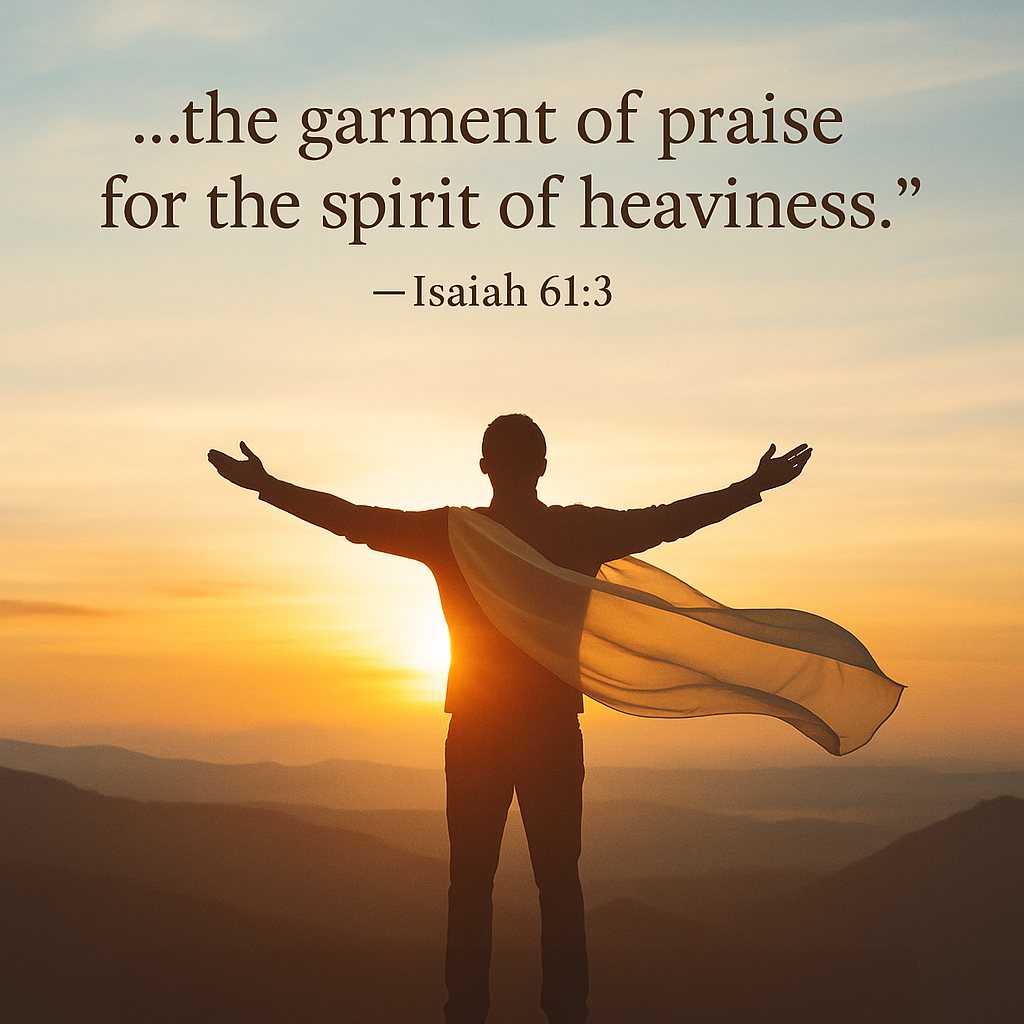
    the garment of praise for the spirit of heaviness…”
    — Isaiah 61:3 KJV

    We don’t talk about it much in church, but many believers know what it feels like to carry a spirit of heaviness.

    It’s more than a bad mood. It’s despair. It’s a weight. A mental, emotional, even spiritual weight. It settles on your soul and won’t go away. You may feel foggy, discouraged, anxious, or even spiritually numb. It clutters your thinking and clouds your connection with God. And it lies to you:

    “You’re too far gone.”
    “You’ll never get through this.”
    “No one sees what you’re going through.”

    If that sounds familiar, you’re not alone. And you’re not stuck.


    What Is the Spirit of Heaviness?

    In simple terms, the “spirit of heaviness” is despair. It is a kind of spiritual oppression — a fog that can weigh you down mentally and emotionally. It’s not always clinical depression (though it can overlap), and it doesn’t mean you’re weak or broken. But it is real, and it is something Scripture speaks directly to.

    And here’s the good news: God has a weapon for this.


    Praise Is More Than a Mood — It’s a Weapon of Glory

    Isaiah 61 says God gives us “the garment of praise for the spirit of heaviness.” That’s not just poetic. It’s strategic. Praise is how we fight back.

    Praise isn’t just celebrating when life feels good. It’s declaring God’s goodness when life feels heavy. It’s not ignoring pain — it’s choosing to lift your eyes above it.

    Praise is spiritual warfare.
    Praise is rebellion against hopelessness.
    Praise is speaking truth louder than the lies.

    You don’t have to feel it to choose it. Sometimes the most powerful praise comes through tears and trembling hands. When you choose to praise, you’re reaching for the garment God has offered you — and it fits.

    And there’s even more power packed into that idea.

    The Hebrew word “kāḇôḏ” (כָּבוֹד), often translated as glory, comes from a root that means “heavy” or “weighty.” In this context, kabad praise is praise that carries substance. It’s not shallow or surface-level. It’s thick with the reality of who God is.

    So while the enemy wants to bury you under the weight of heaviness, God invites you to carry a different kind of weightHis own glory. That’s what praise does. It shifts the heaviness from despair to honor. From sorrow to strength.


    Final Thought: Wear the Garment

    You may feel like you’re walking around with a heavy cloak on your shoulders. But God has laid out something better — a garment of praise. It doesn’t magically make your problems disappear, but it lifts your heart to a higher place.

    Put it on. Even if it feels awkward at first. Even if all you can say is, “God, I trust You.” That’s praise. That’s the beginning of the battle.


    Call to Action

    If you’re struggling under a spirit of heaviness, take 5 minutes right now.
    No phone. No noise. Just you and God.

    • Speak His name out loud.
    • Thank Him for who He is — even if you don’t feel it yet.
    • Sing a song of worship or read a Psalm.

    Then do it again tomorrow. And the next day.
    Praise isn’t a one-time fix — it’s a daily choice to fight from victory, not for it.

    You’re not alone.
    You’re not defeated.
    You’re dressed for battle.