Pastor Bradshaw’s Blog

  • Two Paths. One Savior.

    This past Sunday was a special one — my first Sunday as pastor at Star Hope Baptist Church. And there’s no better place to begin than Psalm 1.

    Psalm 1 is more than the first chapter in the Psalms — it’s the front door to the whole book. It invites us in… and it also forces us to decide.

    There are only two paths in life, the psalmist says:
    – One that’s rooted, fruitful, and known by God.
    – And one that’s hollow, drifting, and headed toward ruin.

    We don’t like stark choices like that. But Psalm 1 is lovingly clear. And it doesn’t just show us the difference between the righteous and the wicked — it shows us the difference between real life and spiritual death.

    The way of the righteous is marked by delight in God’s Word. Not just reading it out of duty, but loving it. Meditating on it. Letting it shape how we think, how we live, how we treat people.

    The blessed person in Psalm 1 is like a tree — planted, nourished, strong. That kind of life doesn’t come from self-help. It comes from being rooted in God’s truth.

    The wicked, on the other hand, are compared to chaff — that thin, useless husk that blows away in the wind. It looks like something… until the storm hits. And then it’s gone.

    I told a story Sunday about two friends. One stayed grounded in Scripture and stood strong through trial. The other slowly drifted from God’s Word — and when life hit hard, he had nothing to hold him. That’s not just an illustration. It’s real life. I’ve seen it again and again.

    Psalm 1 calls us to examine our direction.
    Are we being shaped more by the voices of the world… or by the voice of God?
    Are we building lives that will stand… or lives that will scatter when the winds pick up?

    Here’s the good news: Jesus is the truly Blessed Man. He walked the path of righteousness for us. He rejected evil, delighted in the Father’s will, and bore our judgment on the cross. Now, by faith in Him, we can be planted — forgiven, fruitful, and secure forever.

    So the question Psalm 1 asks us is simple and urgent:

    Which path are you on?

    One leads to life.
    One leads to ruin.
    And only one Savior can put you on the right road.

    Let’s be people of the Word.
    Let’s be rooted.
    Let’s walk the path that leads to life.

  • My Favorite Psalms

    “Songs for Every Season of the Soul”

    We’ve started a new sermon series called My Favorite Psalms — and I’ll be honest with you: that’s not just a clever title. These are psalms that have shaped my life. They’ve given me words when I didn’t know what to pray. They’ve lifted my head when I was discouraged. They’ve challenged me when I got comfortable.

    The book of Psalms is a gift from God. It’s ancient, yes — but it’s honest. Raw. Real. It captures the whole range of human experience. Joy, sorrow, anger, trust, guilt, wonder — it’s all there. The Psalms teach us how to worship, how to lament, how to repent, and how to hope.

    Over the next few weeks, we’ll walk through several psalms that are especially meaningful to me. But my bigger prayer is that they’ll become meaningful to you. Because no matter what season of life you’re in — whether you’re on the mountaintop or deep in a valley — there’s a psalm for you. And more importantly, there’s a Savior who meets you there.

    Come join us on Sunday mornings through August as we open the Psalms and discover how God meets us in every season of life — in joy and in sorrow, in strength and in struggle — and how His Word invites us to live with deeper trust, lasting hope, and a heart rooted in Him.

    Let’s walk this path together.

    — Pastor Bradshaw

  • His Only Banner Over Me Is Love

    Sometimes I feel like I’m being pulled in every direction—responsibilities, distractions, expectations, and the occasional temptation to chase after things that never satisfy. In those moments, it’s not that I’ve forgotten who Jesus is… it’s that I’ve wandered from remembering who I am to Him.

    There’s a lyric form an old Petra song (“First Love”) that always grabs my heart:

    “Your only banner over me is love.”

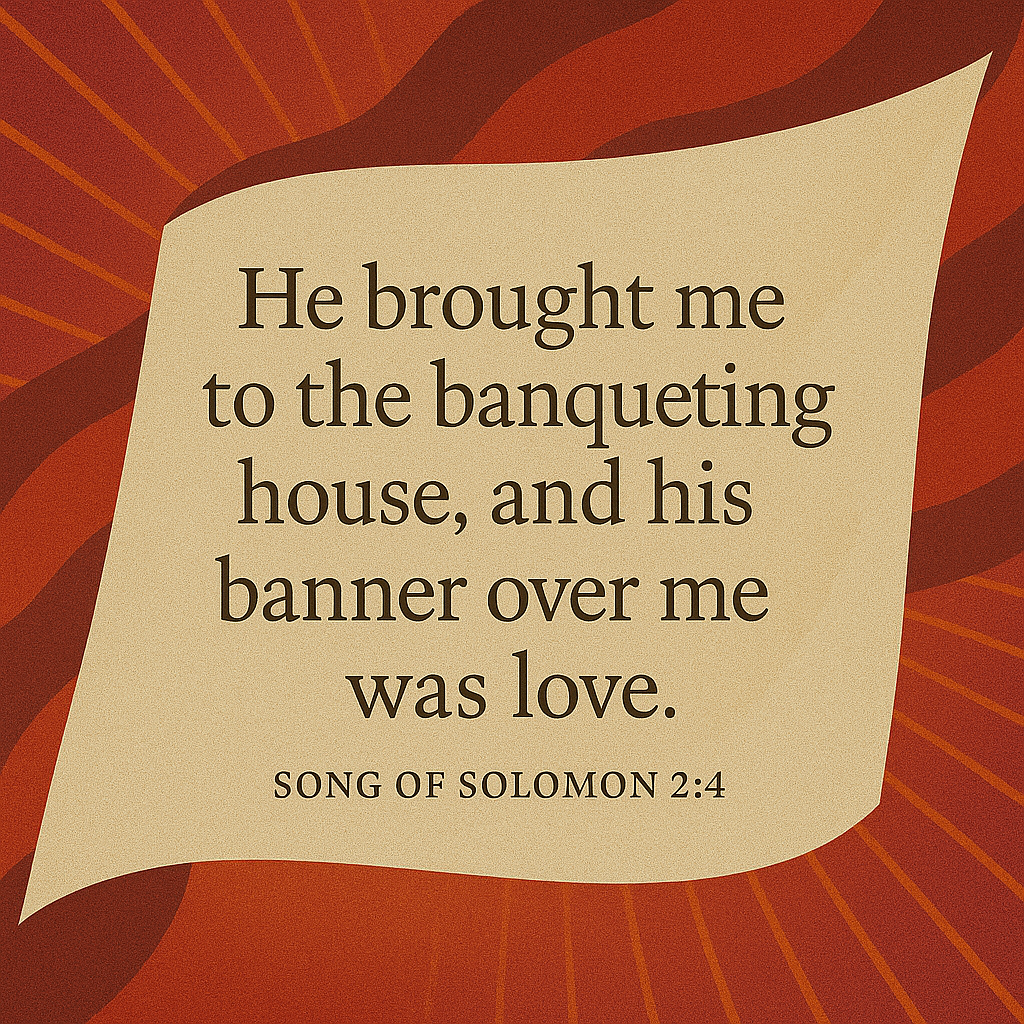
    It echoes a verse tucked into the love poetry of Song of Solomon 2:4:

    “He brought me to the banqueting house, and His banner over me was love.”

    In the ancient world, a banner wasn’t just decoration. It was identity. It marked whose army you were in, what nation you belonged to, or who you followed. It was a sign of belonging and allegiance.

    But the banner God flies over His people isn’t a war flag or a scoreboard tallying our wins and losses.

    It’s love.

    Not Performance. Not Shame. Just Love.

    We’re prone to imagine that God’s posture toward us changes based on how well we’re doing spiritually. If I’m reading my Bible, praying hard, making good choices—then God is pleased, right? But if I’ve been distracted, drifting, or struggling with sin—then maybe He’s disappointed, holding back, or just waiting for me to get it together.

    That’s not the God of the Bible.

    “but God shows His love for us in that while we were still sinners, Christ died for us.” (Romans 5:8)

    God doesn’t fly a banner that says, “Try harder” or “Almost good enough.”
    He flies one banner over His children: “Loved.”
    Not because we’ve earned it, but because Jesus did.

    For the Wandering Heart

    This matters deeply—especially for anyone who feels the tension between knowing the truth and struggling to live it out. The Christian life isn’t about trying to impress God. It’s about remembering who we are in Christ and returning—again and again—to the one who loved us first.

    When your heart starts to drift, when the world seduces your affections, when you feel unworthy, look up.

    See the banner He’s still flying over you.
    It hasn’t changed.
    It never will.

    From the Song:
    “Because You first loved me, Jesus, You will always be my First Love.”

    Return to your First Love. The banner is still up.

     A PRAYER

    Jesus, thank You that the banner over my life isn’t based on my performance but on Your perfect love. When I wander, remind me who I am in You. Woo me back with Your kindness. Help me rest under the covering of Your love—and let it be the banner I live under every day. Amen.

  • When the Weight Won’t Lift: Fighting the Spirit of Heaviness with Praise

    “…to give them beauty for ashes,
    the oil of joy for mourning,
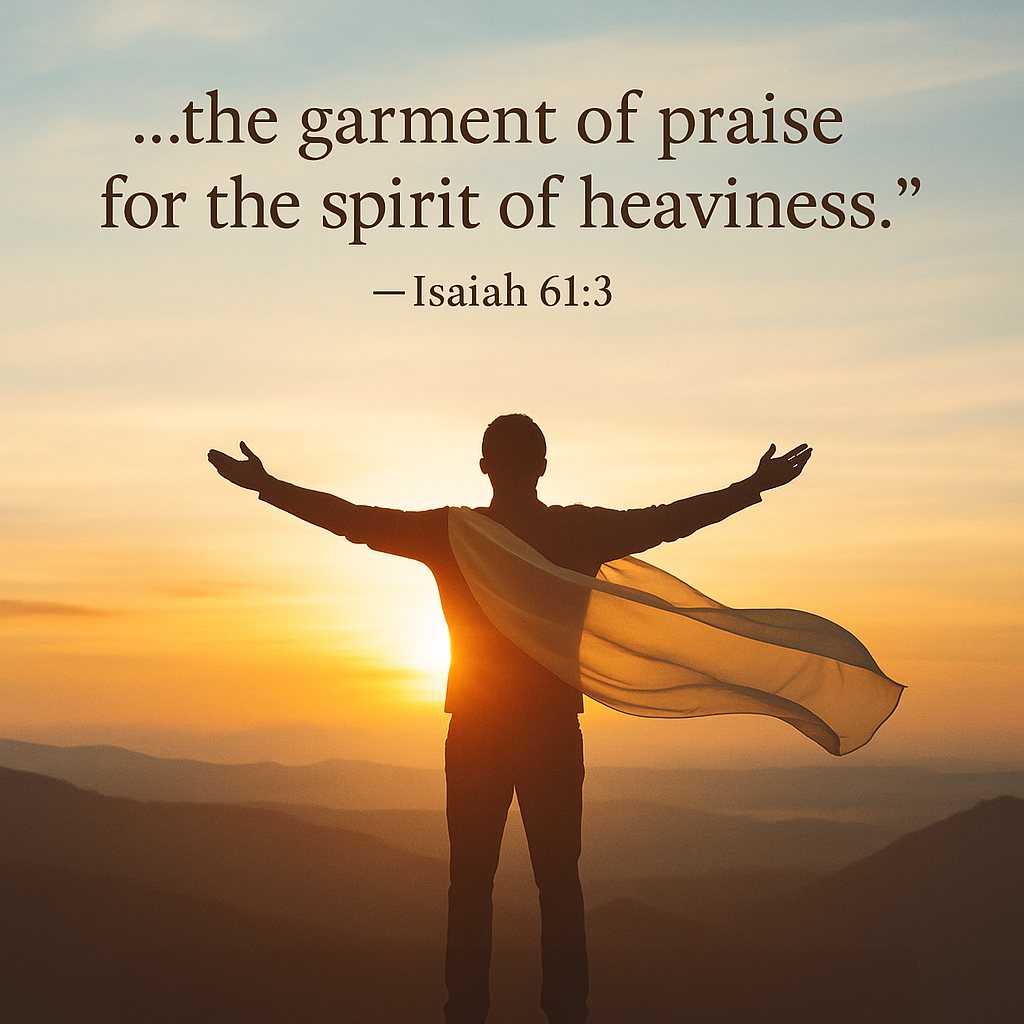
    the garment of praise for the spirit of heaviness…”
    — Isaiah 61:3 KJV

    We don’t talk about it much in church, but many believers know what it feels like to carry a spirit of heaviness.

    It’s more than a bad mood. It’s despair. It’s a weight. A mental, emotional, even spiritual weight. It settles on your soul and won’t go away. You may feel foggy, discouraged, anxious, or even spiritually numb. It clutters your thinking and clouds your connection with God. And it lies to you:

    “You’re too far gone.”
    “You’ll never get through this.”
    “No one sees what you’re going through.”

    If that sounds familiar, you’re not alone. And you’re not stuck.


    What Is the Spirit of Heaviness?

    In simple terms, the “spirit of heaviness” is despair. It is a kind of spiritual oppression — a fog that can weigh you down mentally and emotionally. It’s not always clinical depression (though it can overlap), and it doesn’t mean you’re weak or broken. But it is real, and it is something Scripture speaks directly to.

    And here’s the good news: God has a weapon for this.


    Praise Is More Than a Mood — It’s a Weapon of Glory

    Isaiah 61 says God gives us “the garment of praise for the spirit of heaviness.” That’s not just poetic. It’s strategic. Praise is how we fight back.

    Praise isn’t just celebrating when life feels good. It’s declaring God’s goodness when life feels heavy. It’s not ignoring pain — it’s choosing to lift your eyes above it.

    Praise is spiritual warfare.
    Praise is rebellion against hopelessness.
    Praise is speaking truth louder than the lies.

    You don’t have to feel it to choose it. Sometimes the most powerful praise comes through tears and trembling hands. When you choose to praise, you’re reaching for the garment God has offered you — and it fits.

    And there’s even more power packed into that idea.

    The Hebrew word “kāḇôḏ” (כָּבוֹד), often translated as glory, comes from a root that means “heavy” or “weighty.” In this context, kabad praise is praise that carries substance. It’s not shallow or surface-level. It’s thick with the reality of who God is.

    So while the enemy wants to bury you under the weight of heaviness, God invites you to carry a different kind of weightHis own glory. That’s what praise does. It shifts the heaviness from despair to honor. From sorrow to strength.


    Final Thought: Wear the Garment

    You may feel like you’re walking around with a heavy cloak on your shoulders. But God has laid out something better — a garment of praise. It doesn’t magically make your problems disappear, but it lifts your heart to a higher place.

    Put it on. Even if it feels awkward at first. Even if all you can say is, “God, I trust You.” That’s praise. That’s the beginning of the battle.


    Call to Action

    If you’re struggling under a spirit of heaviness, take 5 minutes right now.
    No phone. No noise. Just you and God.

    • Speak His name out loud.
    • Thank Him for who He is — even if you don’t feel it yet.
    • Sing a song of worship or read a Psalm.

    Then do it again tomorrow. And the next day.
    Praise isn’t a one-time fix — it’s a daily choice to fight from victory, not for it.

    You’re not alone.
    You’re not defeated.
    You’re dressed for battle.

  • MD Anderson

    Originally written in 2014.

    I’m in the cafeteria at MD Anderson Cancer Center. My mom is getting some tests done. To my left sits a group of Japanese doctors. They’re visitors. The only thing I know about them is that one of the female doctors gave up her chair so that our family could all be seated. I say, “Thank you.” She elegantly bows her head in acknowledgement.

    To the right across the aisle is an Indian man with a bad comb-over. Next to him is a man who clearly has spent some time lifting weights. Just beyond him sits a black lady with a tube attached to her chest next to a clearly visible scar. She looks like she’s praying. Not too far from them is a teenage girl whose bald head announces the reason we are all here.

    Some, like us, are here for an initial visit hoping for a diagnosis that doesn’t have the dreaded “c-word.” Some have been here long enough  that their bodies have been weakened by the poison that is being used to fight the “c-word.” There are too many of them. A father and son sharing a tablet computer while they wait. A husband gently holding his wife’s hand. A teenage girl hanging out with her mom. Another bald man…sitting alone…staring off into the distance. A lady in green shirt that looked like a turtle shell whose smile and returning hair seemed to be saying, “There’s hope.” A Chinese lady whose eyes peer above a mask that covers the rest of her face. Our eyes met. I smiled. Her mask changed shape. I hope it was a smile.

    You don’t have to be a rocket scientist to figure out that the “c-word” is no respecter of race or age. It doesn’t care if you have a bad comb-over or a perfect hair-style. It doesn’t notice if you have great muscles or if you’ve never been to a gym. It. Just. Strikes.

    And so we wait. And wait. Some for a diagnosis. Some for the next treatment…linked together by the dreaded “c-word.”

    The people who work here do what they can to make you feel comfortable. Nurses smile as they go about their work. Volunteers have conversations with patients that help to take your mind off of things. A lady comes by delivering free hot tea or coffee or hot chocolate. I’ll remember the happy nurse on the elevator who invited is in to a crowded elevator. “C’mon on in, honey, we’re all family here.” Yeah, let’s be linked together by that.

    The tag line on the signs here at MD Anderson is “Making Cancer History.” May it be so. Until then, I pray. For the patients…for doctors and nurses and researchers…for my friends, Shannon and Amy…for my momma…

    Right now, we wait…and pray.

    >>>>>> April 24, 2025

    Now, 11 years later, it’s Dad’s turn. We’re not in those same halls, but the waiting feels just as heavy. I catch myself thinking of those others like I did years ago—the ones I watched and quietly prayed for. Different place, different time, but the same questions, the same hoping. This time, it’s our family again, holding our breath, waiting for answers. Will you pray for him? For clarity in the treatment plan, for healing, and for the kind of peace that only God can give.

  • My professor asked me what God has taught me.

    Image is from Baptist Press.

    What God has taught me this semester is honestly hard to put into words. It’s been a season of being humbled and broken in ways I didn’t expect. He’s shown me just how fragile everything really is. Landing in the ICU with diabetic ketoacidosis shook me. Trying to manage my health since then has been overwhelming at times. And then, losing a former student to suicide…I still don’t have the words.

    In the middle of it all, I’ve wrestled with a lot of doubt. I’ve questioned my calling, felt completely out of place at times, and been frustrated with myself…especially when I didn’t feel like I had anything left to give. There were days I seriously wondered if I was cut out for this.

    Through all of it, God has kept reminding me that these students I’m called to serve… they’re worth every bit of extra effort. Every late night prepping, every conversation, every moment of showing up…it matters. I’ve felt the weight of it more than ever, and I think that’s exactly what God wanted to teach me: love deeper, teach well, and never take this calling for granted.

    I’m 53 years old. God is still writing my story. I think I will trust Him.

  • Faith in the Storm

    I’ve been sitting with Matthew 14:22–33 this week, and I can’t shake the image of Peter stepping out of that boat.

    Jesus had just fed thousands, the crowds were fired up, and He immediately sent His disciples away. Why? John tells us it’s because the people were about to force Him into kingship. Jesus knew the hearts of the crowd…and the hearts of His friends. So, He sent them into a boat, into a storm.

    Let that sink in: Jesus sent them into the storm.

    It wasn’t an accident. And it wasn’t punishment. It was preparation.

    Out in the middle of that storm, Jesus came walking toward them. And Peter stepped out of the boat. For a moment, his eyes were locked on Jesus, and he did something no one else in the boat had the courage to do: he walked on water.

    But then… the waves. The wind. The fear.

    Peter started to sink.

    Can I just say… I’ve been there.

    I’ve had moments where I stepped out in faith, sure I was doing what God called me to do… only to get overwhelmed when the storm rolled in. Fear crept in. Doubt whispered. And like Peter, I cried out, “Lord, save me!”

    And just like He did for Peter, Jesus didn’t hesitate. He didn’t lecture first. He didn’t shame him.

    He reached out His hand.

    Scripture implies they walked back together to the boat—Jesus and Peter, side by side.

    And when they climbed in, the storm stopped.

    That’s a mark of a disciple.

    Not that we never doubt. Not that we never sink.

    But that we lean on Jesus when circumstances get scary.

    Because He’s always there. In the storm. In the fear. In the faith. In the fall.

    And yes… in the rescue.

    Friend, if you’re in a storm right now, lean in. He’s closer than you think.